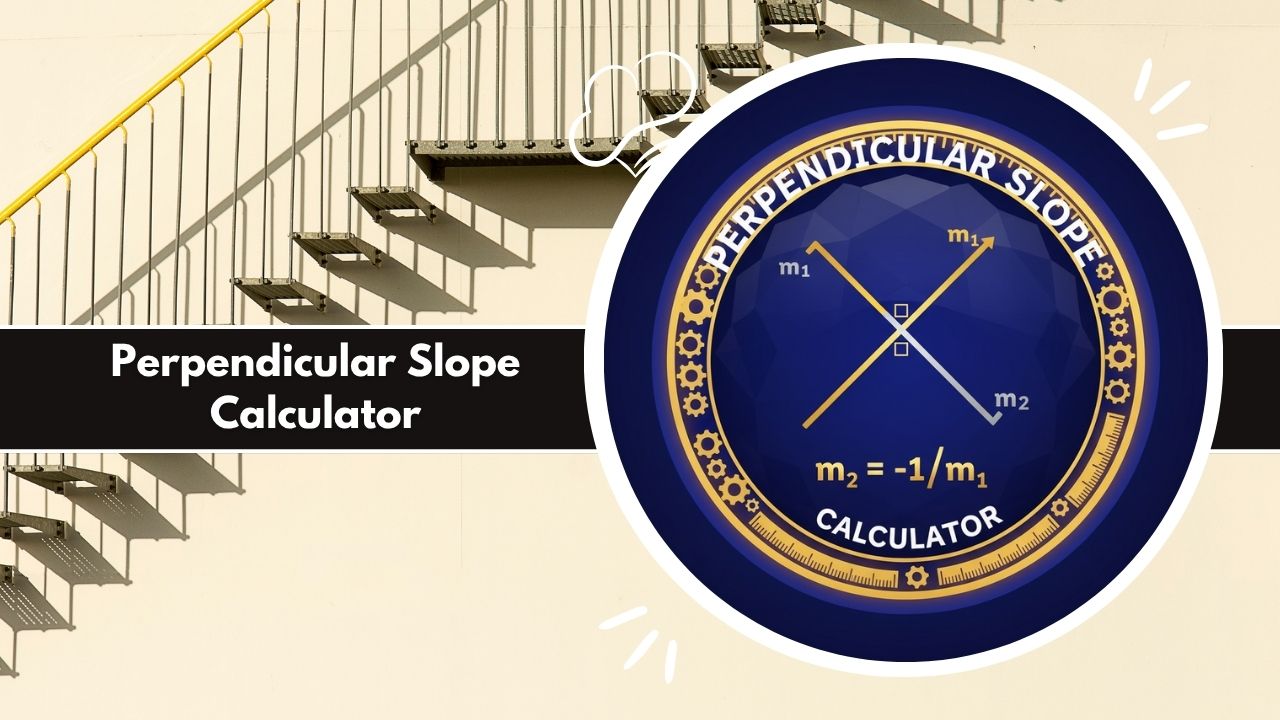
Instantly find the slope of a perpendicular line. Use our Perpendicular Slope Calculator to calculate negative reciprocals, line equations, and intersection points for math and design.
Results
Equation Breakdown
| Quantity | Value |
|---|
Graph
The Perpendicular Slope Calculator is a powerful online geometry tool designed to instantly find the slope of a line perpendicular to any given line. This specialized Perpendicular Slope Calculator simplifies core concepts in algebra and coordinate geometry, making complex calculations accessible for technical users and students alike.
Calculating the perpendicular relationship between two lines is fundamental in analytical design, physics, and advanced mathematics. Manually finding the negative reciprocal and deriving the resulting line equation can be time-consuming and error-prone. Our Perpendicular Slope Calculator eliminates this complexity.
The Perpendicular Slope Calculator instantly computes the original line’s slope, the perpendicular slope (the negative reciprocal), and the full line equation in slope-intercept (y = m * x + b) or point-slope form. It also calculates essential geometric parameters like the intersection point and the distance from a given coordinate to the original line.
This tool is an ideal resource for students needing instant feedback on homework, architects ensuring structural integrity, and engineers verifying parallel and perpendicular orientations in CAD models. The Perpendicular Slope Calculator ensures real-time accuracy and provides a foundation for visual slope interpretation via its optional graphing support.
Use this browser-based, fast, and accurate Perpendicular Slope Calculator now. It requires no downloads and is compatible with all modern devices, delivering professional-grade results instantly.
How It Works (Step-by-Step)
Using the Perpendicular Slope Calculator is a simple, precise process designed for maximum mathematical accuracy and user efficiency. The tool accepts multiple formats for defining the original line.
Simple, Precise Guide:
- Define the Original Line: Select an input mode from the options available on the Perpendicular Slope Calculator. You can define the line by:
- Entering the known slope (m).
- Providing two coordinate points, (x1, y1) and (x2, y2).
- Inputting the coefficients of a standard form equation (A * x + B * y + C = 0).
- Inputting the slope (m) and y-intercept (b) of a slope-intercept equation (y = m * x + b).
- Defining two points for a perpendicular bisector calculation (where the perpendicular line passes exactly through the midpoint).
- Define the Pass-Through Point: (Optional, unless using the perpendicular bisector mode) Input a specific coordinate (x0, y0). This point is necessary for the Perpendicular Slope Calculator to generate the exact perpendicular line equation that passes through it.
- Click Calculate Perpendicular Slope: The tool instantly processes the data.
- Instantly View Results: Review the comprehensive results, which include:
- The Original slope (m1).
- The Perpendicular slope (m2 = -1 / m1).
- The complete equation of the perpendicular line in slope-intercept form and standard form.
- Export or Copy: Export or copy all generated results for math projects, lessons, or technical design work.
The Negative Reciprocal Rule
The core function of the Perpendicular Slope Calculator relies on the negative reciprocal rule. Two lines are perpendicular if and only if the product of their slopes is always negative one (m1 * m2 = -1). For example, if the original line has a slope of 2, the perpendicular slope is -1/2. The Perpendicular Slope Calculator automates the computation of this specific reciprocal relationship.
The calculator supports decimal, fractional, and negative values for all inputs. This flexibility allows for flexible use in educational and technical applications, ensuring students and professionals can accurately work with any gradient. The tool simplifies algebraic learning by providing instant feedback, visual clarity, and formula-based accuracy, especially crucial in complex coordinate geometry problems. The result is a guaranteed accurate perpendicular slope.
Why Use This Perpendicular Slope Calculator
The Perpendicular Slope Calculator is an indispensable tool for anyone working with lines, angles, and equations in geometry or applied mathematics. Its benefits extend far beyond a simple negative reciprocal calculation.
Key Benefits of the Perpendicular Slope Calculator:
- Instantly Calculate Perpendicular Slopes: It determines the perpendicular gradient or the parallel slope instantly, saving significant manual calculation time. This speed is vital for time-sensitive engineering checks or quick homework verification.
- Provides Line Equations in Multiple Forms: Unlike basic tools, this Perpendicular Slope Calculator generates the complete line equation in the common slope-intercept (y = m * x + b) and standard (A * x + B * y + C = 0) forms.
- Helps Visualize Line Orientation: The built-in plotting feature helps users visualize how the original line, the perpendicular line, and their 90 degree intersection angle relate in the coordinate geometry system.
- Reduces Manual Errors: The most frequent error in line relationship calculations is forgetting the negative sign or incorrectly calculating the reciprocal. The Perpendicular Slope Calculator eliminates these algebraic pitfalls.
- Universal Utility: It is a valuable resource for students, teachers, engineers, and designers who rely on accurate slope and line equation calculations.
- 100% Online, Fast, and Accurate: The tool is browser-based, ensuring immediate access and reliable, accurate geometry computations without the need for software installation.
Real-World and Academic Applications
This Perpendicular Slope Calculator is highly useful for geometry assignments, ensuring perfect accuracy when defining the rise and run. Teachers use it to rapidly generate complex problem sets and check student solutions involving line equations.
In professional settings, the Perpendicular Slope Calculator supports critical functions:
- CAD Planning: Architects and engineers use it to define perpendicular boundaries and structural constraints in Computer-Aided Design (CAD).
- Physics: It is used in motion graphs and vector analysis to decompose forces into parallel and perpendicular components relative to a surface or trajectory.
- Data Analysis: Finding perpendicular regression lines or calculating the shortest distance (normal vector) from a data point to a trend line is simplified by this slope tool.
The Perpendicular Slope Calculator saves time by automatically computing slope reciprocals and generating clean, ready-to-use line equations. It strongly emphasizes its importance in learning perpendicular relationships, identifying intersecting angles, and supporting real-world engineering and design applications that demand high geometric accuracy.
Mastering Perpendicular Lines with the Perpendicular Slope Calculator
The study of lines and their relationships forms the backbone of coordinate geometry. Whether you are solving a high school algebra problem or designing a foundation that requires perfectly perpendicular components, understanding the slope, gradient, and the relationship between lines is paramount. The Perpendicular Slope Calculator is the ultimate technical resource for mastering this geometric concept.
What is Slope and How is it Measured?
Slope, often represented by the letter $m$ and referred to as the gradient, measures the steepness and direction of a line in the coordinate plane. It is calculated by determining the ratio of the vertical change (rise) to the horizontal change (run) between any two coordinate points, (x1, y1) and (x2, y2), on the line.
The formula for calculating the slope is: Slope (m) = Delta y / Delta x = (y2 - y1) / (x2 - x1)
Understanding the slope is the first step in coordinate geometry. A line with a positive slope indicates an upward trend. Conversely, a negative slope indicates a downward trend. A slope of zero represents a horizontal line (no rise), while an undefined slope indicates a vertical line (no run). The Perpendicular Slope Calculator first determines the original slope m1 from your chosen input (points or equation) to set the foundation for all subsequent geometry calculations.
The Essential Difference: Perpendicular vs. Parallel
In coordinate geometry, lines can relate to each other in three main ways: intersecting, parallel, or perpendicular. The Perpendicular Slope Calculator focuses on the latter two critical relationships.
Parallel Lines
Two lines are parallel if and only if they have the exact same slope (m1 = m2). Parallel lines maintain the same gradient and distance from each other, ensuring they never intersect. This relationship is often used to ensure uniformity in design and construction.
Perpendicular Lines
Two lines are perpendicular if they intersect to form a right angle (90 degrees). This is the most crucial relationship for this Perpendicular Slope Calculator. Two non-vertical lines are perpendicular if their slopes are negative reciprocals of each other. This is the central concept utilized by the Perpendicular Slope Calculator to find the correct perpendicular gradient.
The Negative Reciprocal Formula
The logic behind the perpendicular relationship is precise and forms the core of the Perpendicular Slope Calculator.
The Formula
The perpendicular slope (m2) is derived from the original slope (m1) using the formula: m2 = -1 / m1
This means that if a line has a positive gradient, its perpendicular line must have a negative gradient, and vice versa. The ultimate geometric proof is that the product of these perpendicular slopes is always negative one (m1 * m2 = -1). The Perpendicular Slope Calculator automates this crucial step, saving you the manual process of inverting the fraction and applying the negative sign.
Step-by-Step: Finding the Perpendicular Line Equation
Simply knowing the perpendicular slope (m2) is not enough to define the line fully. To find the complete line equation that is perpendicular to a given line and passes through a specific coordinate, three pieces of information are needed:
- The original line's slope (m1).
- The perpendicular slope (m2), calculated by the Perpendicular Slope Calculator.
- A specific point (x0, y0) on the perpendicular line (the pass-through point).
Using the Point-Slope Form
The Perpendicular Slope Calculator uses the point-slope form as the foundational step for generating the final line equation. The point-slope form is: y - y0 = m * (x - x0)
The Perpendicular Slope Calculator applies the calculated m2 and the input coordinate (x0, y0) directly into this formula. This gives an immediate, precise expression of the perpendicular line.
Converting to Slope-Intercept Form
While the point-slope form is algebraically robust, the slope-intercept form is often preferred for plotting and general use. The slope-intercept form is: y = m * x + b
where $b$ is the y-intercept (the point where the line crosses the vertical axis).
The Perpendicular Slope Calculator algebraically rearranges the point-slope result to solve for $y$, thus isolating the slope (m2) and the y-intercept ($b$). This provides the line equation in the most common and easily plottable format. The tool ensures the highest level of coordinate geometry accuracy in this conversion process.
Real-World Applications of Perpendicular Slopes
The ability to accurately calculate the perpendicular slope and its resulting line equation is not just academic; it is vital across numerous professional disciplines. The Perpendicular Slope Calculator supports these technical applications.
Architecture and Engineering
Architects and civil engineers use perpendicular slopes constantly. They rely on them to ensure that walls, beams, and columns meet at right angles, providing structural stability. For instance, calculating the slope of a roof and then defining the line of a perpendicular drainage channel requires this exact geometric relationship. The Perpendicular Slope Calculator is a crucial validation tool for these critical angle and line equation checks.
Data and Physics Analysis
In data analysis, linear regression models establish a trend line. Finding the distance (the error) from a specific data point to that trend line involves calculating a perpendicular distance. In physics, when analyzing force vectors applied to an inclined plane, the forces are typically decomposed into components that are parallel and perpendicular to the plane's surface. The unit normal vector—which is perpendicular to the line of the surface—is easily found using the outputs of the Perpendicular Slope Calculator.
Computer Graphics and CAD
Computer-Aided Design (CAD) software and 3D graphics engines rely on perpendicular relationships to define surfaces, normals, and light sources. The intersection of three perpendicular planes defines the $x, y, z$ coordinate system. Any failure in calculating the correct perpendicular gradient leads to inaccurate rendering or flawed physical models. Professionals rely on the Perpendicular Slope Calculator for verification and immediate calculation of the correct line equation.
Avoiding Common Slope Mistakes
The most frequent algebraic mistakes when dealing with line relationships involve:
- Forgetting the Negative Sign: Simply taking the reciprocal (1 / m1) instead of the negative reciprocal (-1 / m1). This results in a parallel slope calculation error.
- Confusing Relationships: Confusing the condition for perpendicularity (negative reciprocal) with the condition for parallelism (same slope).
- Handling Zero and Undefined Slopes: Incorrectly calculating the reciprocal of a horizontal line (m = 0) or a vertical line (m = undefined).
The Perpendicular Slope Calculator eliminates these calculation errors instantly, ensuring the correct perpendicular slope is found every time, whether the original gradient is a simple integer or a complex fraction. The tool provides a visual aid to solidify the concept of rise and run in the context of the original gradient and its perpendicular counterpart.
Benefits of the Online Perpendicular Slope Calculator
The Perpendicular Slope Calculator is more than just a formula engine; it is a learning and efficiency tool.
- Speed and Accuracy: It provides instant feedback, saving significant time in geometry assignments or complex design checks. The guaranteed accuracy is its most valuable asset.
- Visualization: The optional plotting features help users visualize exactly how the original line, the resulting perpendicular line, and the intersection angle relate in the coordinate system, greatly improving conceptual clarity.
- Comprehensive Output: The tool goes beyond just the slope, providing intersection points, distance from a point to the line, and direction vectors, making it a complete coordinate geometry solution. The Perpendicular Slope Calculator is the only tool you need for complete line analysis.
Technical Details
The Perpendicular Slope Calculator is built for high speed, accuracy, and ease of use across all technical and academic environments.
Calculation Flow
- Flexible Inputs: The Perpendicular Slope Calculator accepts flexible inputs: a single slope (m) or two coordinate points ((x1, y1), (x2, y2)). It also handles inputs from slope-intercept or standard equation forms, automatically converting the coefficients (A, B, C) into the primary original slope (m1).
- Perpendicular Slope Calculation: The core calculation engine first determines the original slope (m1). It then applies special handling for edge cases:
- If m1 is undefined (a vertical line), the perpendicular slope m2 is 0 (a horizontal line).
- If m1 is 0, m2 is undefined (a vertical line).
- Otherwise, it uses the m2 = -1 / m1 rule to find the negative reciprocal.
- Line Generation: With the calculated m2 and the input pass-through point (x0, y0), the Perpendicular Slope Calculator generates the complete line equation of the perpendicular line using the point-slope form. This is then algebraically rearranged to solve for the final slope-intercept (y = m * x + b) and standard form (A * x + B * y + C = 0) equations.
- Optional Plotting Feature: The built-in visualization feature uses Chart.js to accurately plot the line equations on a Cartesian coordinate system, allowing for visual understanding of the gradient and intersection angle.
Accuracy and Reliability
The Perpendicular Slope Calculator supports decimal and fractional values and handles all negative and positive slopes correctly. All complex algebraic and geometric calculations are processed quickly and locally within your browser environment. This ensures maximum speed and user privacy since no data is transmitted to an external server for processing. The tool is compatible across all devices and browsers, making the Perpendicular Slope Calculator a reliable, universal tool for coordinate geometry needs.
FAQs (Frequently Asked Questions)
What does the Perpendicular Slope Calculator calculate?
The Perpendicular Slope Calculator calculates the perpendicular slope (m2), the complete line equation (in multiple forms), the intersection point, and the distance from a given coordinate to the original line.
How do I find a perpendicular slope?
To find a perpendicular slope (m2), you must first find the original line’s slope (m1), then calculate its negative reciprocal. The Perpendicular Slope Calculator performs this instantly using the formula m2 = -1 / m1.
What’s the formula for a perpendicular line?
The formula for the slope of a perpendicular line is m2 = -1 / m1. To find the full line equation, the Perpendicular Slope Calculator then uses the point-slope formula, y - y0 = m2 * (x - x0), using a given coordinate point.
What’s the difference between parallel and perpendicular slopes?
Parallel slopes are identical (m1 = m2), meaning the lines will never intersect. Perpendicular slopes are negative reciprocals (m1 * m2 = -1), meaning the lines will intersect at a 90 degree angle.
Can I use this to find perpendicular equations through a point?
Yes, the Perpendicular Slope Calculator is specifically designed to calculate the exact perpendicular line equation that passes through any given coordinate point, providing the final line equation in y = m * x + b form.
Does it support fractions and negative slopes?
Absolutely. The Perpendicular Slope Calculator supports all real numbers, including positive, negative, decimal, and fractional values, ensuring accurate geometry calculations for every gradient.
Can I plot both lines visually?
Yes, the Perpendicular Slope Calculator includes an optional plotting feature that visually displays the original line, the perpendicular line, the pass-through point, and the intersection angle in the coordinate system.
Is this calculator suitable for students?
This Perpendicular Slope Calculator is highly suitable for students learning coordinate geometry. It provides immediate accuracy checks, reduces algebraic errors, and visualizes the relationship between parallel and perpendicular lines.
Does it work on mobile and tablet devices?
Yes, the Perpendicular Slope Calculator is a browser-based, responsive tool designed for universal compatibility and high geometric accuracy across all mobile, tablet, and desktop devices.
Related Tools & Calculators:
- Ramp Slope Calculator
- Graph Slope Calculator
- Point Slope Calculator
- Wheelchair Ramp Slope Calculator
- ADA Ramp Slope Calculator
- Roof Slope Calculator
- Cubic Foot Calculator
- Best Scientific Calculator
- Math Solver Calculator
- Student T-Value Calculator