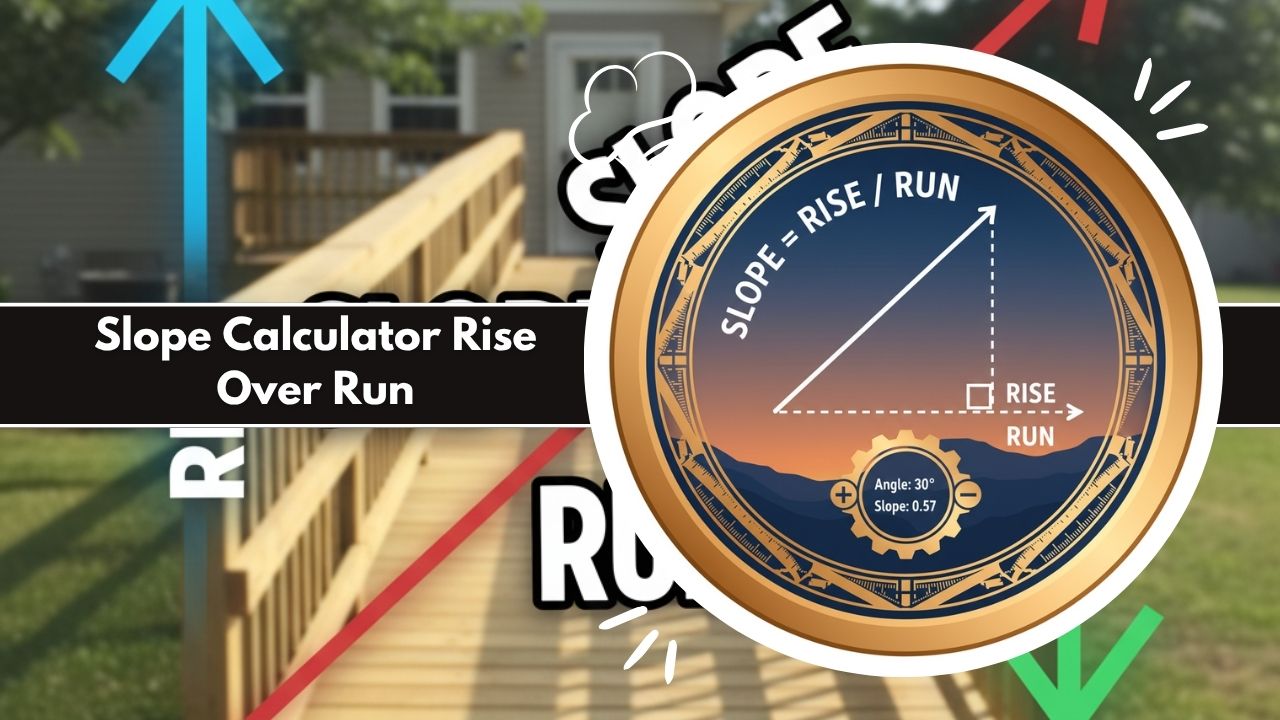
Calculate slope rise over run instantly with the Slope Calculator Rise Over Run. Find precise slope, gradient, percent grade, and angle. An accurate tool for geometry, math, and construction.
Inputs
Tip: slope m = rise / run. For two points, m = (y₂ − y₁) / (x₂ − x₁). Percent grade = 100 × m. Angle θ = atan(m).
Results
| Quantity | Value | Formula | Notes |
|---|
The Slope Calculator Rise Over Run is a universal slope calculation tool. It’s meticulously designed to determine the slope of a line using the fundamental rise over run formula. This Slope Calculator Rise Over Run is an essential resource for professionals and students in geometry, algebra, physics, construction, and design. It is used to accurately measure incline, angles, and gradients for any project.
With instant computation, this slope tool provides three key outputs, essential for any gradient analysis.
- Slope Ratio (m): The direct result of
rise / run. This ratio is the core of any slope calculation. - Slope Percentage (%): The percent grade, calculated as
(Rise ÷ Run) × 100. This percent is critical for understanding incline steepness. - Slope Angle (°): The angle of inclination, derived using trigonometry conversion (inverse tangent).
This Slope Calculator Rise Over Run helps users visualize and understand slope direction, gradient steepness, and linear relationships on a graph. It is essential for designing ramps, determining roof pitch, engineering roads, and solving coordinate geometry problems.
The Slope Calculator Rise Over Run supports multiple units for distance (inches, feet, meters) and accurately processes both positive slopes (an incline) and negative slopes (a decline). As a browser-based application, it delivers accurate, immediate, and easy-to-understand results from our Slope Calculator Rise Over Run for any slope or ratio calculation, making it a top-tier slope measurement tool.
How It Works (Step-by-Step)
Our Slope Calculator Rise Over Run simplifies slope measurement into a few simple steps. The interface is designed for clarity and precision, providing instant, accurate slope results for any rise over run problem. This gradient calculator is a robust tool for technical work.
Step 1: Enter the Rise First, input the “Rise” value. The rise represents the vertical distance or the total height difference between two points. A positive rise value indicates a vertical increase (a positive incline), while a negative rise signifies a downward slope. This rise is the first part of the ratio.
Step 2: Enter the Run Next, input the “Run” value. The run is the horizontal distance between the same two points. This run value is key for the rise over run ratio and must be a non-zero number for a defined slope. Our Slope Calculator Rise Over Run uses this run value to find the gradient.
Step 3: Click “Calculate Slope” Once your rise and run values are entered, click the calculate button in the Slope Calculator Rise Over Run. The tool immediately processes this information using standard geometric and trigonometry equations to determine the slope, angle, and percent grade.
Step 4: Instantly View Your Results The Slope Calculator Rise Over Run provides a comprehensive breakdown of the slope, including:
- Slope Ratio (m): The primary slope value, expressed as a decimal ratio.
- Slope Percentage (%): The gradient expressed as a percent, which is common in road design and construction.
- Slope Angle (°): The slope angle in degrees, calculated using trigonometry.
The Slope Calculator Rise Over Run can also be used for reverse calculations. For instance, if you know the desired angle or percent, you can adjust the rise or run inputs to find the missing distance variable for your design.
For documentation, you can easily export or print the computed slope results. This Slope Calculator Rise Over Run handles all conversions between percent, ratio, and angle formats automatically. This makes the Slope Calculator Rise Over Run an indispensable tool for construction planning, creating a graph, or engineering projects where slope and gradient accuracy are critical.
Why Use This Tool
The Slope Calculator Rise Over Run offers numerous benefits for anyone needing to measure or understand slope. This tool is more than a simple gradient calculator; it’s a complete solution for incline analysis.
- Instant Calculation: Instantly calculate slope using rise over run inputs.
- Multiple Conversions: The Slope Calculator Rise Over Run automatically converts the slope ratio into degrees, percent, and a simplified ratio.
- Versatile Inputs: Works for both positive incline (uphill) and negative slope (decline), providing a full range of slope data.
- Unit Support: Supports imperial (feet, inches) and metric (meters, centimeters) units for distance.
- Wide Application: This gradient tool is ideal for education, engineering, and construction.
- Accessible and Secure: 100% browser-based Slope Calculator Rise Over Run ensures data is secure and results are immediate.
The rise over run formula defines slope as the vertical change divided by the horizontal distance. This is a fundamental principle in geometry, physics, and architecture. However, performing these slope calculations manually—especially converting the slope ratio to an angle using trigonometry—can be tedious and prone to mathematical errors. A mistake in a gradient calculation can be costly.
The Slope Calculator Rise Over Run eliminates these challenges. It provides a reliable and error-free solution for any gradient calculation. Students can use this Slope Calculator Rise Over Run to verify homework, understand how to graph a line, and visualize linear relationships.
Engineers and builders can rely on this Slope Calculator Rise Over Run for designing infrastructure, planning surface gradients for drainage, or ensuring ramps meet accessibility standards.
The Slope Calculator Rise Over Run is a versatile educational and professional tool, bridging the gap between mathematical theory and practical slope application. Using this slope tool ensures accuracy for any rise over run problem.
Understanding Slope: The Rise Over Run Formula
In mathematics, geometry, and physics, “slope” is a fundamental concept describing the steepness, incline, or gradient of a line. It is a precise measurement of how much a line rises or falls for a given horizontal distance. The most common and intuitive way to express this slope is through the “rise over run” formula. This ratio is the bedrock of understanding linear relationships and gradients.
- Rise: This is the vertical change (distance) between two points on a line. It represents the “up” or “down” movement. A positive rise means an upward incline, while a negative rise means a downward incline.
- Run: This is the horizontal change (distance) between the same two points. It represents the “left” or “right” movement and is typically read from left to right.
The slope, often represented by the letter m in equations, defines this relationship. It’s a critical ratio in physics, engineering, and construction, defining everything from a road’s gradient to a financial graph’s trend. The Slope Calculator Rise Over Run is the perfect tool to compute this value instantly.
The Formula for Slope and Why It Matters in Geometry and Design
While our Slope Calculator Rise Over Run is instant, understanding the math is key to applying the results.
The Basic Slope Formula (m = rise / run)
The primary formula for slope is beautifully simple: Slope (m) = Rise / Run
For example, if a ramp has a vertical rise of 2 feet and a horizontal run of 10 feet, the slope is 2 / 10 = 0.2. This decimal value is the slope ratio. It’s a dimensionless quantity, meaning it’s the same regardless of whether you measure the distance in feet, meters, or inches (as long as you are consistent). A higher ratio means a steeper slope or incline.
Calculating Slope Percentage (Grade)
In many real-world applications, especially construction and civil engineering, slope is expressed as a percent, often called “grade” or “gradient.” This is calculated by multiplying the slope ratio by 100.
Slope Percentage = (Rise / Run) × 100
Using the same ramp example, the percent grade would be 0.2 × 100 = 20%. This percent is easy to understand: it means the ramp rises 20 feet for every 100 feet of horizontal distance. The Slope Calculator Rise Over Run provides this percent grade automatically.
Finding the Slope Angle (Degrees)
Trigonometry is the bridge between the slope ratio and the actual angle of inclination, measured in degrees. The angle (theta, or θ) is found using the inverse tangent (or atan) function, which is the opposite of the tangent function (tan).
Angle (°) = atan(Slope Ratio) or Angle (°) = atan(Rise / Run)
For our ramp with a slope ratio of 0.2, the angle is atan(0.2), which is approximately 11.31°. This angle is crucial for engineering specifications and design blueprints. Our Slope Calculator Rise Over Run performs this complex trigonometry calculation instantly.
Real-World Uses in Construction, Architecture, Physics, and Math
The ability to accurately calculate slope is vital across countless industries. The Slope Calculator Rise Over Run is a go-to tool for these professionals.
- Construction and Engineering: In construction, slope is non-negotiable. It determines road gradients (ensuring they aren’t too steep for vehicles), ramp accessibility (meeting ADA standards for incline), roof pitch (the angle needed for water and snow drainage), and land gradient (shaping land to ensure water drains away from buildings).
- Architecture and Design: Architects use slope to design functional and aesthetic spaces. This includes the incline of staircases, the angle of a sloped ceiling, or the gradient of a landscape design.
- Mathematics and Education: Slope is a cornerstone of algebra and geometry. The Slope Calculator Rise Over Run is an excellent educational tool for students to visualize linear equations (like
y = mx + b, wheremis the slope), solve coordinate geometry problems, and understand the relationship between a ratio, an angle, and a graph. - Physics and Data Analysis: In physics, slope represents a rate of change. On a distance-time graph, the slope is velocity. In data analysis, the slope of a trendline can indicate the rate of growth or decline in a dataset.
Difference Between Positive, Negative, Zero, and Undefined Slopes
The value of the slope provides critical information about the line’s direction on a graph. The Slope Calculator Rise Over Run can handle all four types.
- Positive Slope (Incline): A positive slope (
m > 0) occurs when the rise is positive (for a positive run). This means the line moves uphill from left to right on a graph. This is a positive gradient. - Negative Slope (Decline): A negative slope (
m < 0) occurs when the rise is negative (a “drop”). The line moves downhill from left to right. This is a negative gradient, essential for calculating drainage. - Zero Slope (Horizontal Line): A zero slope (
m = 0) occurs when the rise is 0, but the run is not. This represents a perfectly flat, horizontal line. It has no incline or decline. - Undefined Slope (Vertical Line): An undefined slope occurs when the run is 0, but the rise is not. This represents a perfectly vertical line, like a wall. Division by zero is mathematically undefined, so the slope is “undefined,” which corresponds to an angle of 90°.
How to Calculate Slope on a Graph or Coordinate Plane
Sometimes, you don’t have the rise and run directly, but you have two points on a graph or coordinate plane. Let’s call them Point 1 (x1, y1) and Point 2 (x2, y2). You can find the slope using these coordinates.
- The Rise is the vertical change:
y2 - y1 - The Run is the horizontal change:
x2 - x1
The slope formula thus becomes: m = (y2 - y1) / (x2 - x1) Our Slope Calculator Rise Over Run also supports this two-point calculation method, providing a comprehensive solution for all slope-finding needs.
Step-by-Step Guide to Using the Slope Calculator Rise Over Run
Our Slope Calculator Rise Over Run is designed for maximum simplicity and accuracy.
- Input Your Data (Rise and Run): Begin by entering your two known values. Input the vertical distance in the “Rise” field and the horizontal distance in the “Run” field. Remember to use a negative value for the rise if you are measuring a downward slope.
- Select Units and Precision: For clarity in your results, you can select your measurement units (e.g., feet, meters, inches). While the slope ratio itself is unitless, specifying units is helpful for distance-related outputs. You can also select the number of decimal places for your slope, percent, and angle results.
- Analyze Your Instant Results: Click “Calculate” on the Slope Calculator Rise Over Run to see a full breakdown. The tool provides the slope ratio (m), percent grade, and angle in degrees. It also provides a detailed table with the line equation, intercepts, and segment distance, offering a complete picture for technical projects.
How to Verify Slope Accuracy Manually or Digitally
While the Slope Calculator Rise Over Run is extremely accurate, you can verify a slope manually. The easiest way is to simplify the rise over run ratio. For example, a rise of 6 and a run of 8 (6/8) simplifies to 3/4, or a slope of 0.75. To check the angle, you would use a scientific calculator and compute atan(0.75), which is 36.87°. To check the percent, 0.75 * 100 = 75%. Our Slope Calculator Rise Over Run does all this for you, eliminating errors.
Common Mistakes in Slope Calculation and How to Avoid Them
Simple errors can lead to incorrect slope results. Be careful to avoid:
- Mixing Up Rise and Run: This is the most common error. Always divide the vertical change (rise) by the horizontal change (run).
- Unit Inconsistency: Ensure both rise and run are in the same units of distance (e.g., both in feet or both in inches) before calculating the slope ratio.
- Sign Errors: Forgetting to use a negative value for the rise on a downward slope. This will incorrectly report a positive incline.
- Confusing Percent and Angle: Percent grade and angle (degrees) are two very different measurements. A 100% grade (
rise=run) is a 45° angle, not a 90° angle. The Slope Calculator Rise Over Run provides both to avoid this confusion.
Applications in Road Design, Ramps, Roofs, and Structural Gradients
The Slope Calculator Rise Over Run is a precise tool for these critical applications.
- Roads: Highway engineers use percent grade to design roads. A 7% grade is very steep for a long-haul truck.
- Ramps: ADA-compliant ramps must have a slope ratio of 1:12 (a rise of 1 inch for a run of 12 inches), which is an 8.33% gradient and an angle of
4.76°. - Roofs: Roof “pitch” is a form of rise over run, often expressed as a ratio like 4:12 (a 4-inch rise for a 12-inch run). Our Slope Calculator Rise Over Run can convert this ratio to an angle (
18.4°) instantly.
This makes the Slope Calculator Rise Over Run an essential, precise, and reliable tool for anyone working with incline or gradient values. It prevents manual errors, saves time, and translates complex trigonometry calculations into instant, understandable answers for any rise over run problem.
Technical Details
The Slope Calculator Rise Over Run functions as a powerful, client-side application that runs entirely within the user’s web browser. This approach ensures maximum speed and privacy, as no data is sent to a server for processing.
Inputs: The Slope Calculator Rise Over Run accepts primary inputs for “Rise” (vertical distance) and “Run” (horizontal distance). It also provides an alternative mode for calculating slope from two coordinate points (x1, y1) and (x2, y2).
It also allows for input selection from multiple imperial and metric measurement systems (inches, feet, meters, centimeters) to provide context for distance-based results like segment length. Users can also select the desired precision (decimal places) for the outputs.
Core Processing and Outputs: Upon calculation, the Slope Calculator Rise Over Run‘s JavaScript engine performs several computations simultaneously:
- Slope Ratio (m): It calculates the slope
mby dividing theriseby therun. This is the core rise over run ratio. - Slope Percentage (%): It computes the gradient or percent grade by multiplying the slope ratio
mby 100. - Slope Angle (°): It uses the trigonometry function
atan(inverse tangent) on the slope ratiom. The resulting angle in radians is then converted to degrees. - Detailed Breakdown: The Slope Calculator Rise Over Run also calculates the hypotenuse (segment distance) using the Pythagorean theorem (
√(rise² + run²)) and determines the line equation iny = mx + bformat.
The Slope Calculator Rise Over Run automatically converts and displays all three primary slope outputs—ratio, percentage, and angle. It also handles edge cases, such as a run of zero, which results in an “undefined” slope (a 90° vertical incline), and a rise of zero, which results in a zero slope (a 0° horizontal line).
Functionality: The Slope Calculator Rise Over Run is built with responsive HTML, CSS, and JavaScript, ensuring it works flawlessly on all browsers, mobile phones, and tablets. All slope processing is done locally. This guarantees privacy and provides instant gradient results without network lag.
The Slope Calculator Rise Over Run also includes features to export or print the detailed slope results, making it versatile for educational and engineering documentation.
Frequently Asked Questions (FAQs)
What does the Slope Calculator Rise Over Run do?
It calculates the slope of a line using the rise over run formula. The Slope Calculator Rise Over Run gives you the slope ratio, percent grade, and angle instantly.
How is slope calculated?
Slope is found by dividing the vertical rise by the horizontal run. This ratio shows how steep or flat a line or surface gradient is.
What units can I use in this calculator?
You can use any consistent units of distance—inches, feet, meters, or centimeters—for rise and run. The slope ratio itself is unitless.
What is a positive and negative slope?
A positive slope means a line has a positive rise (an incline) from left to right. A negative slope has a negative rise (a decline) from left to right.
How do I convert slope into degrees or percentage?
You don’t need to. The Slope Calculator Rise Over Run automatically converts the slope ratio into a percent grade and an angle in degrees for easy interpretation.
What does a 0 slope mean?
A slope of 0 represents a completely flat or horizontal line. This means there is zero rise over the run.
Can this calculator be used for construction and design?
Yes. The Slope Calculator Rise Over Run is ideal for calculating slope in roads, ramp incline, roof angle (pitch), and land gradient.
Is it accurate for academic and engineering use?
Yes. The Slope Calculator Rise Over Run uses precise geometric and trigonometry formulas to ensure accuracy for both educational and technical projects requiring slope measurement.
Does it work on mobile and tablet devices?
Yes. This Slope Calculator Rise Over Run is fully optimized for all devices with instant, responsive slope results.
Related Tools & Calculators:
- Drain Pipe Slope Calculator
- Pipe Slope Calculator
- Driveway Slope Calculator
- Grade Slope Calculator
- Perpendicular Slope Calculator
- Ramp Slope Calculator
- Graph Slope Calculator
- Point Slope Calculator
- Wheelchair Ramp Slope Calculator
- ADA Ramp Slope Calculator
- Roof Slope Calculator