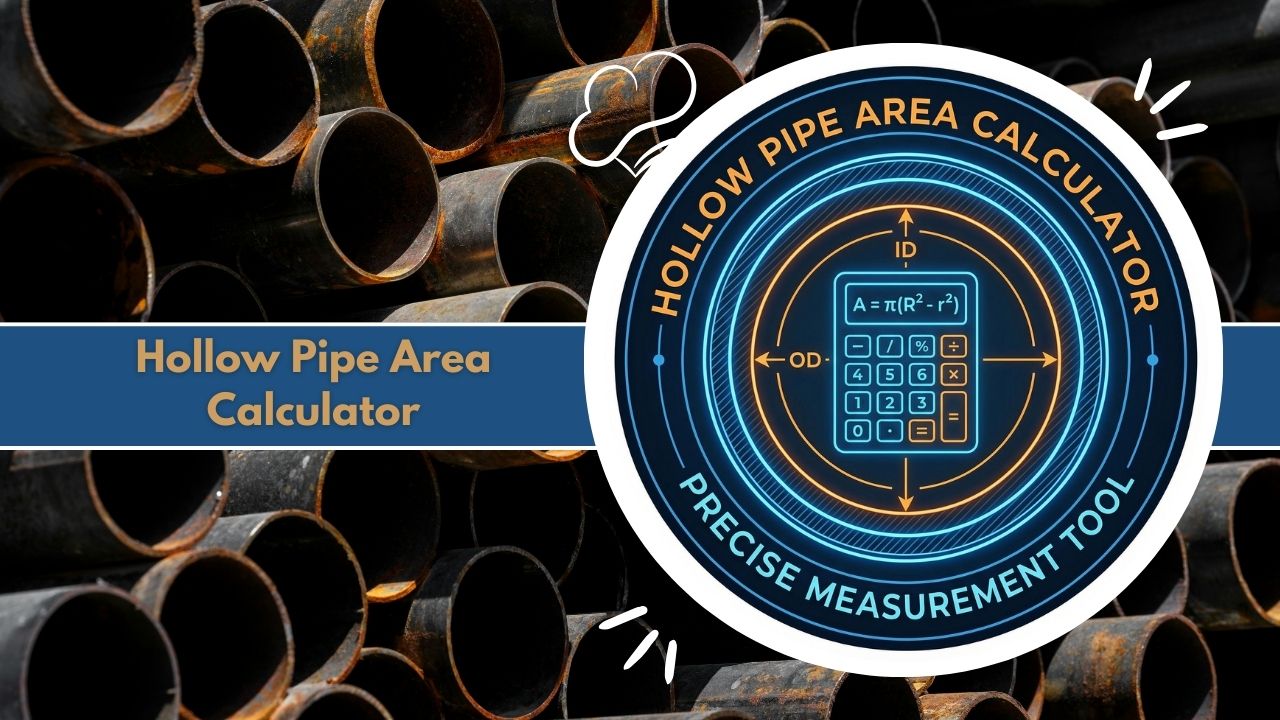
Use the Hollow Pipe Area Calculator to determine cross-sectional area, flow capacity, and structural mass. Essential for engineers and fabricators needing precise pipe geometry data.
Advanced Professional Hollow Pipe Area Calculation Suite (ISO/ASTM Standard)
Introduction to the Hollow Pipe Area Calculator
In the exacting world of mechanical engineering, hydraulic systems, and structural fabrication, the geometry of cylindrical components is the foundation of design integrity. The Hollow Pipe Area Calculator is an essential digital utility designed to transform raw dimensional measurements into critical engineering data.
Whether a project involves designing a high-pressure steam line or specifying structural columns for a skyscraper, accurate knowledge of the pipe’s cross-section is non-negotiable. This area determines everything from the weight of the material to the volume of fluid the pipe can transport.
The Hollow Pipe Area Calculator bridges the gap between simple linear measurements and complex area properties. By processing the fundamental relationships between diameters and wall thickness, this tool provides immediate answers that would otherwise require manual geometric derivation. For engineers, machinists, and procurement specialists, utilizing a reliable Hollow Pipe Area Calculator ensures that every specification meets the rigorous demands of safety and efficiency.
Importance of Inner and Outer Diameter Measurement
The physical reality of any pipe is defined by three primary dimensions: the Outer Diameter (OD), the Inner Diameter (ID), and the Wall Thickness. The Hollow Pipe Area Calculator relies on the precise interaction of these variables. The Outer Diameter represents the physical footprint of the pipe—how much space it occupies and how it fits into clamps, flanges, or pass-throughs. Conversely, the Inner Diameter is the functional void—the space available for fluid flow or cabling.
A common oversight in manual calculation is neglecting the strict relationship between these dimensions. The wall thickness is mathematically half the difference between the OD and the ID. A Hollow Pipe Area Calculator requires accurate inputs because even a millimeter of deviation in wall thickness significantly alters the cross-sectional area. This “annulus” area represents the solid material, directly correlating to the pipe’s strength and mass.
How Hollow Pipe Area Affects Flow and Structural Performance
The output from a Hollow Pipe Area Calculator serves two distinct engineering disciplines: structural analysis and fluid dynamics. Structurally, the cross-sectional area of the pipe wall (the annulus) is proportional to the pipe’s tensile strength and load-bearing capacity. A larger material area generally indicates a heavier, stronger pipe capable of withstanding greater axial loads.
In fluid dynamics, the focus shifts to the internal void. The Hollow Pipe Area Calculator can often derive the flow area (bore area) simultaneously. If a pipe wall is too thick for a given OD, the internal flow area shrinks, increasing fluid velocity and pressure drop, potentially leading to system cavitation or inefficiency. By using the Hollow Pipe Area Calculator, designers can balance these conflicting needs—optimizing wall thickness to ensure structural safety without choking the necessary flow rate.
What the Hollow Pipe Area Calculator Is
Purpose and Technical Role of the Calculator
The Hollow Pipe Area Calculator is a specialized computational algorithm designed to solve the geometry of an annulus—the ring shape formed by two concentric circles. Its primary technical role is to mathematically subtract the area of the inner circle (the hole) from the area of the outer circle (the total footprint) to isolate the area of the solid material.
While basic geometry can solve for a solid circle, a Hollow Pipe Area Calculator is specifically tuned for the nuances of tubing and piping. It eliminates the need to manually look up values in extensive ASTM or ISO piping tables. The tool acts as a rapid-verification system, allowing users to confirm that the physical dimensions of a pipe match the required cross-sectional specifications for a project.
Benefits of Automated Hollow Pipe Cross-Section Analysis
Automation allows for speed and reliability. In a fast-paced fabrication environment, manually calculating pi * R^2 for the OD and then subtracting pi * r^2 for the ID for fifty different pipe segments is prone to keystroke errors. The Hollow Pipe Area Calculator standardizes this process.
Furthermore, the benefits extend to cost estimation. Raw materials like steel, aluminum, and copper are often sold by weight. Weight is calculated by multiplying the volume of the material by its density. Since volume is simply the Cross-Sectional Area multiplied by Length, the Hollow Pipe Area Calculator is the first step in accurate budgeting. It prevents over-ordering expensive alloys and ensures that weight limits for shipping and handling are respected.
What the Hollow Pipe Area Calculator Does
Supported Hollow Pipe Types and Material Categories
The geometric principles used by the Hollow Pipe Area Calculator are universal. Gravity and geometry do not discriminate based on material. Therefore, the calculator supports a vast array of pipe types:
- Carbon Steel Pipes: Used in oil, gas, and structural piling.
- Stainless Steel Tubing: Common in food processing and medical devices.
- PVC and CPVC: Standard for residential plumbing and drainage.
- Copper Piping: Used for HVAC and water supply lines.
- Concrete Pipes: Utilized in large-scale civil sewer systems.
As long as the object is a hollow cylinder with a consistent cross-section, the Hollow Pipe Area Calculator can process the dimensions. It handles seamless pipes, welded pipes, and extruded structural tubing with equal precision.
Precision Level and Output Metrics Provided
A professional Hollow Pipe Area Calculator provides more than just a single number. It typically outputs:
- Annulus Area: The cross-sectional area of the pipe material itself (vital for weight and strength).
- Internal Area: The cross-sectional area of the empty space (vital for flow capacity).
- External Surface Area: The total surface area of the outside of the pipe (vital for painting and coating estimations).
The precision is usually determined by the user’s input. If dimensions are entered to three decimal places, the Hollow Pipe Area Calculator maintains that high resolution, providing answers in square millimeters (mm²), square inches (in²), or square meters (m²).
Key Features of the Hollow Pipe Area Calculator
Adjustable Inputs for ID, OD, and Wall Thickness
Flexibility is a hallmark of a good Hollow Pipe Area Calculator. In real-world scenarios, an engineer rarely has all three dimensions explicitly stated. They might measure the Outer Diameter with calipers and know the Wall Thickness from the schedule rating. Alternatively, they might know the required Inner Diameter for flow and the Outer Diameter for clearance. The calculator allows users to input any two of these three variables to solve for the area.
Advanced Handling of Multiple Pipe Standards and Sizes
Industrial pipes come in standardized sizes (e.g., NPS 2, DN 50), but the actual dimensions differ from the nominal names. A 2-inch pipe does not have a 2-inch OD. The Hollow Pipe Area Calculator allows for the input of the exact decimal dimensions found in engineering standards like ASME B36.10M. Whether the pipe is a microscopic capillary tube or a massive municipal water main, the mathematical logic scales flawlessly.
User Workflow Designed for Fast Engineering Calculations
The interface of the Hollow Pipe Area Calculator is designed for linear efficiency. The workflow typically involves:
- Selecting the unit of measurement (Metric or Imperial).
- Inputting the known dimensions.
- Executing the calculation.
- Reviewing the breakdown of areas.
This streamlined process minimizes the cognitive load on the user, allowing engineers to run multiple “what-if” scenarios rapidly—such as comparing the area difference between Schedule 40 and Schedule 80 pipes—using the Hollow Pipe Area Calculator.
Mathematical Formulas Used in the Hollow Pipe Area Calculator
Core Formula for Hollow Pipe Area: π(R² − r²)
The calculation performed by the Hollow Pipe Area Calculator is based on the geometry of an annulus. The formula requires determining the area of the outer circle and subtracting the area of the inner circle.
The standard formula is: Area = pi * ( R * R – r * r )
Where:
- Area is the Cross-Sectional Area of the material.
- pi is the mathematical constant approximately equal to 3.14159.
- R is the Outer Radius (Outer Diameter / 2).
- r is the Inner Radius (Inner Diameter / 2).
Using Diameter Inputs Correctly to Avoid Miscalculations
Most users interact with pipes using diameters, not radii. Converting diameter to radius manually can introduce rounding errors. Therefore, the Hollow Pipe Area Calculator often utilizes the diameter-based version of the formula internally:
Area = ( pi / 4 ) * ( OD * OD – ID * ID )
Where:
- OD is the Outer Diameter.
- ID is the Inner Diameter.
This formula yields the exact same result but allows the user to input the caliper measurements directly into the Hollow Pipe Area Calculator without intermediate steps.
Required Parameters for Accurate Cross-Section Computation
To generate a valid result, the Hollow Pipe Area Calculator requires a constrained geometry. The absolute minimum data points are two defined dimensions.
- Case A: Outer Diameter + Wall Thickness (Calculator derives ID).
- Case B: Outer Diameter + Inner Diameter (Calculator derives Thickness).
- Case C: Inner Diameter + Wall Thickness (Calculator derives OD).
Without two of these parameters, the geometry is undefined, and the Hollow Pipe Area Calculator cannot function.
Engineering Variables That Influence Pipe Performance
While the Hollow Pipe Area Calculator outputs the area, this value is a variable in more complex performance equations.
- Stress: Force / Area. The area calculated is the denominator in calculating the tensile stress the pipe can hold.
- Weight: Area * Length * Density.
- Thermal Expansion: The cross-sectional area determines the magnitude of force exerted if the pipe expands against a fixed support.
How to Use the Hollow Pipe Area Calculator Step-by-Step
Essential Measurements Needed for Calculation
Before launching the Hollow Pipe Area Calculator, ensure you have accurate measurements. Use digital calipers for small tubes or a pi-tape for large industrial pipes.
- Outer Diameter: Measure at the widest point.
- Wall Thickness: Measure the actual material thickness, not including any coating, paint, or insulation.
Proper Sequence for Entering Dimensions and Units
- Unit Selection: Verify if your measurements are in millimeters, inches, or meters. Mismatched units are the primary cause of calculation errors.
- Data Entry: Input the OD and Wall Thickness into the Hollow Pipe Area Calculator.
- Verify Logic: Ensure the Wall Thickness is less than half of the OD. If the Wall Thickness is exactly half the OD, the pipe would be a solid bar with no hole. If it is more, the geometry is impossible.
- Calculate: Trigger the process to view results.
Expert Recommendations for Accurate Input Collection
Pipes are rarely perfect circles. They have ovality. For the most accurate result from the Hollow Pipe Area Calculator, take three measurements of the diameter at different angles and average them. Similarly, wall thickness can vary due to manufacturing tolerances. Averaging four thickness points (12, 3, 6, and 9 o’clock positions) ensures the Hollow Pipe Area Calculator utilizes a representative value for the computation.
Hollow Pipe Area Calculator Example Calculation
Sample Engineering Dimensions for Demonstration
To illustrate the function of the Hollow Pipe Area Calculator, let us consider a standard steel structural tube.
- Outer Diameter (OD): 100 mm
- Wall Thickness: 5 mm
- Material: Steel
From these inputs, we can derive the Inner Diameter: ID = 100 mm – (5 mm * 2) = 90 mm.
Detailed Calculation Breakdown and Formula Application
Using the Hollow Pipe Area Calculator logic:
- Convert Diameters to Radii:
- Outer Radius (R) = 100 / 2 = 50 mm
- Inner Radius (r) = 90 / 2 = 45 mm
- Apply the Area Formula:
- Area = pi * (R * R – r * r)
- Area = 3.14159 * (50^2 – 45^2)
- Area = 3.14159 * (2500 – 2025)
- Area = 3.14159 * 475
- Final Result:
- Area ≈ 1492.26 mm²
Interpretation of the Final Hollow Pipe Area Result
The Hollow Pipe Area Calculator returns a result of approximately 1492 mm². This figure represents the surface area of the steel face if you were to slice the pipe perpendicularly. An engineer would use this specific number to calculate the weight. If the pipe is 1 meter long and steel density is 7.85 g/cm³:
- Volume = 14.92 cm² * 100 cm = 1492 cm³
- Weight = 1492 * 7.85 = 11,712 grams or 11.7 kg.
This demonstrates how the Hollow Pipe Area Calculator is the starting point for weight estimation.
Practical Applications of the Hollow Pipe Area Calculator
Engineering Uses in Structural and Mechanical Design
In structural engineering, hollow sections (HSS) are preferred for columns because they resist buckling better than solid bars of the same weight. The Hollow Pipe Area Calculator is used to verify that the cross-sectional area meets the required safety factors for compressive loads. It allows engineers to optimize the weight-to-strength ratio of roof trusses, scaffolding, and crane booms.
Fluid Transport and Flow Capacity Estimation
For chemical engineers and plumbers, the internal area derived by the Hollow Pipe Area Calculator is critical. It dictates the flow rate.
- Flow Rate = Velocity * Internal Area. By quickly calculating the internal area for various pipe schedules, a system designer can select a pipe size that keeps fluid velocity within recommended limits to prevent noise and erosion.
Industrial Fabrication, Cutting, and Material Planning
Fabricators use the Hollow Pipe Area Calculator to estimate welding requirements. The cross-sectional area determines the volume of weld metal needed to join two pipes (butt weld). A larger cross-sectional area requires more passes with the welding torch, consuming more filler rod and gas. Accurate calculation helps in quoting jobs and managing consumables inventory.
Hydraulic, Pneumatic, and Thermal System Analysis
In hydraulic cylinders, the Hollow Pipe Area Calculator is used to determine the effective area of the piston side versus the rod side. This differential area is crucial for calculating retraction force versus extension force. In thermal systems, the cross-sectional area of the pipe wall determines the rate of heat conduction along the length of the pipe, influencing insulation requirements.
Advantages of Using a Hollow Pipe Area Calculator
Significant Time Savings Compared to Manual Calculations
The most obvious advantage is efficiency. Manually calculating square roots and exponents is slow. The Hollow Pipe Area Calculator performs these operations instantly. For a project requiring the takeoff of materials for a large plant with hundreds of different pipe sizes, the cumulative time saved by using the calculator is measured in hours or days.
Reduction of Input and Formula Errors
Human error is a constant risk in manual engineering math. Transposing digits or forgetting to square a radius are common mistakes. The Hollow Pipe Area Calculator has the logic hard-coded. As long as the input is correct, the math will be flawless. This reliability is essential for liability protection in professional engineering.
Reliable Accuracy for Professional and Academic Use
Whether used by a student learning fluid mechanics or a licensed Professional Engineer (PE) certifying a blueprint, the Hollow Pipe Area Calculator provides consistent accuracy. It uses high-precision floating-point math, ensuring that rounding errors do not accumulate to significant levels, which is particularly important when dealing with costly materials like titanium or high-nickel alloys.
Common Mistakes When Using a Hollow Pipe Area Calculator
Entering Outer Diameter Instead of Inner Diameter
A frequent error occurs when users measure the inside of a pipe but enter it into the “Outer Diameter” field of the Hollow Pipe Area Calculator. This results in a calculation for a much smaller pipe than intended. Always verify which diameter is being requested by the interface.
Misinterpreting Wall Thickness Measurements
Some users confuse “Schedule” with thickness. Schedule 40 is a standard, not a dimension. Its thickness changes depending on the pipe diameter. Users must look up the actual decimal thickness of Schedule 40 for their specific pipe size before entering it into the Hollow Pipe Area Calculator. Entering “40” as the thickness for a Schedule 40 pipe will result in a massive error.
Forgetting to Convert Between Metric and Imperial Units
If a blueprint is in inches but the Hollow Pipe Area Calculator is set to millimeters, the result will be off by a factor of 25.4 squared. Always ensure the calculator’s unit settings match the source data. If inputs are mixed (e.g., OD in inches, thickness in mm), convert them to a single unit system before entry.
Limitations of a Hollow Pipe Area Calculator
Calculator Assumptions About Perfect Cylindrical Shape
The Hollow Pipe Area Calculator assumes the pipe is a perfect geometric cylinder. In reality, pipes can be slightly oval or have variable wall thickness (eccentricity). The calculator provides the theoretical area. For extremely high-precision aerospace applications, actual physical volume measurement might be required to account for these geometric imperfections.
Limitations in Handling Deformed or Non-Uniform Pipes
The tool cannot account for pipes that are bent, dented, or corroded. If a pipe has significant rust scaling inside, the effective ID is reduced, and the Hollow Pipe Area Calculator results based on the nominal ID will overstate the flow capacity. Users must measure the effective dimensions of used or damaged pipes.
Accuracy Factors for Hollow Pipe Area Calculations
Importance of Precise Diameter Measurement Tools
The output of the Hollow Pipe Area Calculator is only as good as the input. Using a rusty tape measure to determine the wall thickness of a high-pressure pipe is insufficient. Micrometers or ultrasonic thickness gauges should be used to obtain the inputs for the calculator to ensure the result reflects reality.
Effects of Manufacturing Tolerance Variations
All pipes are manufactured to tolerances. A pipe specified as 10mm wall thickness might actually be 9.8mm or 10.2mm. The Hollow Pipe Area Calculator will give a specific number for “10mm”, but the actual physical pipe may vary by +/- 10% depending on the manufacturing standard (e.g., ASTM A53). Engineers should run calculations using the minimum tolerance dimensions to ensure safety.
Formula Differences Used Across Pipe Standards
While the geometric area formula is constant, the definition of “Diameter” can vary. In some plastic piping systems, the pipe is defined by ID. In steel, it is defined by OD (for sizes over 14 inches). Understanding the standard in use is a prerequisite for effectively using the Hollow Pipe Area Calculator.
Industry Standards Related to Hollow Pipe Area Measurement
Plumbing and Mechanical Engineering Pipe Codes
Codes such as ASME B31.1 (Power Piping) and B31.3 (Process Piping) dictate the minimum required wall thickness for pressure containment. The Hollow Pipe Area Calculator is the tool used to verify that the selected pipe meets these area and thickness requirements after corrosion allowance and manufacturing tolerances are subtracted.
Industrial Pipe Specification and Compliance Standards
Standards organizations like ASTM, DIN, and ISO publish dimensional tables. A Hollow Pipe Area Calculator is often used in conjunction with standards like ASTM A106 or ISO 4200. When a quality control inspector measures a batch of pipes, they use the calculator to ensure the cross-sectional area falls within the compliance range specified by these standards.
Troubleshooting Issues in Hollow Pipe Area Calculations
Diagnosing Unexpected or Impossible Outputs
If the Hollow Pipe Area Calculator returns an error or a negative number, it is usually because the calculation is geometrically impossible. This happens if the sum of the wall thicknesses (Wall * 2) is greater than or equal to the Outer Diameter. You cannot have a 100mm pipe with 60mm walls, as the walls would overlap in the center.
Identifying Missing or Incorrect Dimensional Inputs
If the result seems drastically too low, check if the radius was entered instead of the diameter. Since area is a function of the square of the dimension, entering a radius (half size) into a diameter field results in an area that is 1/4th of the correct value.
Fixing Unit Conversion Errors Between Systems
If the result is off by a factor of ~645, you likely calculated in square inches when you needed square millimeters. If off by ~10.76, you mixed square feet and square meters. Reset the Hollow Pipe Area Calculator and strictly adhere to one unit system to resolve this.
Frequently Asked Questions About the Hollow Pipe Area Calculator
What is the primary function of a Hollow Pipe Area Calculator?
It calculates the cross-sectional surface area of the material of a hollow pipe (the annulus) and the internal flow area based on diameter and thickness inputs.
Can the Hollow Pipe Area Calculator determine the weight of the pipe?
Yes, indirectly. By calculating the cross-sectional area and multiplying it by the length and material density, you can determine the total mass.
Does the Hollow Pipe Area Calculator work for square tubes?
No. This specific calculator is designed for cylindrical geometry (circles). Square tubes require a different formula (Width * Height – Inner Width * Inner Height).
What is the difference between OD and ID in the calculator?
OD (Outer Diameter) is the total width of the pipe. ID (Inner Diameter) is the width of the empty space inside. The Hollow Pipe Area Calculator uses the difference between these to find the solid area.
Why is the result important for hydraulics?
The internal area calculated by the tool dictates the flow velocity. Identifying the correct area is crucial for pump sizing and system efficiency.
Can I use this calculator for concrete pipes?
Yes. The Hollow Pipe Area Calculator works for any material (steel, PVC, concrete) because it calculates geometry, not material properties.
What if I only know the Circumference?
You must first convert Circumference to Diameter (Diameter = Circumference / pi) before using the Hollow Pipe Area Calculator.
Does the calculator account for pipe coatings?
No. It calculates the area based on the dimensions entered. If a pipe has a thick lining, you must adjust the ID or OD entered into the Hollow Pipe Area Calculator to account for it.
What units should I use?
You can use any unit (mm, inches, cm) as long as you are consistent. Do not mix inches for OD and mm for thickness within the Hollow Pipe Area Calculator.
Why do I need to know the cross-sectional area?
It is required for calculating tensile load capacity, burst pressure, total volume of material, and cost estimations for construction projects.
Is the calculator applicable to nominal pipe sizes (NPS)?
Only if you input the actual physical dimensions associated with that nominal size. Entering “2” for a 2-inch NPS pipe is incorrect; you must enter “2.375” inches (the actual OD).
How does wall thickness impact the area?
Increasing wall thickness decreases the ID and increases the solid cross-sectional area. The Hollow Pipe Area Calculator reflects this relationship instantly.
Related Tools & Calculators:
- Pipe Area Calculator
- Net Free Area Calculator
- Net Area Calculator
- Mulch Area Calculator
- Lawn Area Calculator
- L Shape Area Calculator
- Kitchen Area Calculator
- Kidney Pool Surface Area Calculator
- Kite Area Calculator
- Fence Area Calculator
- Hip Roof Area Calculator
- T Beam Second Moment of Area Calculator