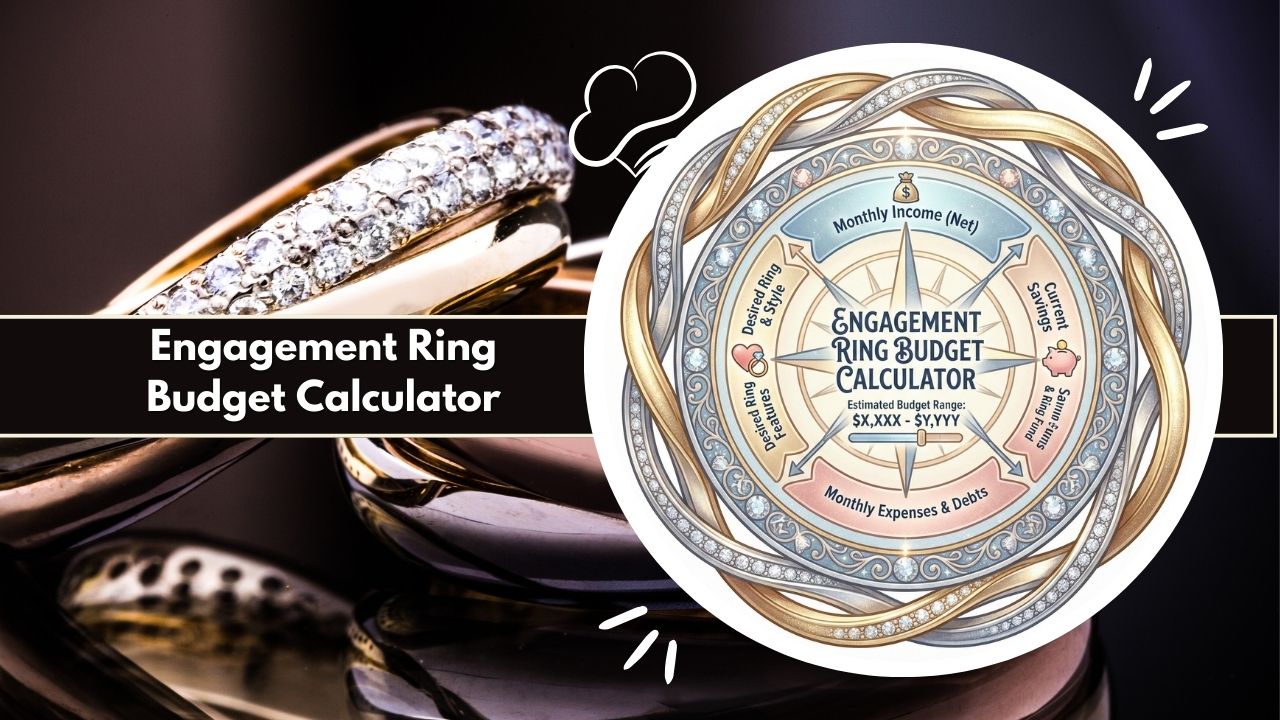
Master your finances with the Engagement Ring Budget Calculator. Analyze income, savings projection, 2025 inflation, and risk scores. Includes carat predictor, market intel, and price simulator.
Visualizing your budget’s buying power across 5 metrics.
| Negotiation Strength | Medium |
|---|---|
| Best Buying Month | January |
| Market Inflation | ~3.4% Projected |
| Scenario | Extra Budget |
|---|---|
| Wait +3 Months | +$0 |
| Save +10% More/Mo | +$0 |
| Partner Expectation | Match ✅ |
Adjust specs to see real-time price impact. Does not affect main budget calculation.
Generating suggestions…
Determining the right amount to spend on an engagement ring is one of the most stressful financial decisions a couple can face. The old, arbitrary “three months’ salary” rule is not only outdated—it is often financially reckless. In today’s economic climate, relying on a generic percentage of gross income ignores the realities of debt, cost of living, and inflation.
The Engagement Ring Budget Calculator solves this problem by shifting the focus from arbitrary rules to personalized financial analysis. Instead of guessing, this tool evaluates your true affordability by processing your net income, fixed expenses, and current savings. It goes beyond simple addition; it applies a sophisticated savings projection model, adjusts for 2025 market inflation, and even predicts the diamond carat size you can realistically afford.
Whether you are a budget-conscious buyer looking to maximize value or a luxury shopper aiming for a high-carat stone without overleveraging, this engagement ring budget planner provides a data-driven roadmap. By integrating a financial risk score and market intelligence, we bridge the gap between your bank account and the jewelry counter, ensuring your proposal is memorable for the right reasons—not because of the debt it caused.
How the Engagement Ring Budget Calculator Works
This engagement ring cost calculator utilizes a multi-layered calculation engine designed to provide a safe, realistic, and market-accurate budget. Unlike simple “income multipliers,” this tool breaks down your buying power into seven distinct analytical phases.
A) Income & Expense Analysis
The foundation of any sound budget is “Disposable Income.” The calculator first establishes your financial baseline by subtracting your fixed monthly expenses (rent, utilities, food) and debt payments from your net monthly income. This isolates the actual discretionary money available for ring savings, ensuring you don’t dip into funds needed for essential living costs.
B) Timeline & Strategy Modeling
Your purchasing power is heavily influenced by when you plan to propose. The tool’s strategy engine allows you to select a timeline (1 to 24 months) and a savings aggressiveness level (Conservative, Standard, or Aggressive). This projects your future savings accumulation, effectively answering the question, “If I save consistently for X months, how much ring can I afford?”
C) Budget-Inflation Adjustment (2025 Model)
Diamonds and precious metals are subject to global economic shifts. The ring budget calculator includes a toggle to adjust for projected 2025 inflation (set at ~4%). This ensures that the budget you calculate today will still have the required purchasing power when you walk into the store months from now.
D) Preference Logic
Not all budgets are created equal. A user prioritizing size (Carat) allocates funds differently than one prioritizing quality (Cut/Clarity). The calculator adapts its recommendations based on your “Priority” selection, ensuring the output aligns with whether you want the biggest rock possible or the most sparkling one.
E) Carat Prediction Engine
One of the most powerful features is the diamond carat calculator algorithm. By cross-referencing your calculated buying power against current market price-per-carat data, the tool predicts the estimated carat weight, color, and clarity grade you can acquire. It removes the mystery of “what will $5,000 actually get me?”
F) Risk Score & Market Intel
Affordability isn’t just about having the cash; it’s about financial safety. The tool calculates a Risk Score (0–100) by analyzing your Debt-to-Income (DTI) ratio and cash flow stress. Simultaneously, the Market Intel layer advises on the best month to buy an engagement ring based on seasonality and assigns a negotiation strength rating to empower you at the jeweler.
G) Interactive Simulator
Finally, the engagement ring price estimator features a real-time simulator. This allows you to toggle variables like Cut, Color, and Carat to see how specific specifications impact market price instantly, helping you visualize trade-offs before you buy.
Inputs & Outputs
To generate an accurate wedding ring budget calculator report, the tool requires specific data points to model your financial health.
Inputs You Can Enter
- Net Monthly Income: Your take-home pay after taxes.
- Fixed Monthly Expenses: Rent/mortgage, utilities, insurance, groceries.
- Monthly Debt Payments: Student loans, credit card minimums, car notes.
- Current Ring Fund: Savings already set aside for the purchase.
- Expected Gifts: Contributions from family (optional).
- Timeline: Number of months until the planned purchase (1–60).
- Aggressiveness Strategy:
- Conservative: Low savings rate (safer for tight budgets).
- Standard: Balanced savings rate.
- Aggressive: High savings intensity (maximum budget).
- Financing Option: Cash, 12-month 0% financing, or 24-month interest-bearing loans.
- Preferences: Priority (Size/Quality), Partner Style (Classic/Glam/Minimal), and Metal Type.
- Inflation Adjustment: Toggle to account for 2025 economic shifts.
Outputs You Get
- Recommended Total Budget: The final, safe dollar amount you can spend.
- Disposable Income: Your true monthly free cash flow.
- Projected Savings: The total accumulated value over your selected timeline.
- Adjusted Buying Power: Budget corrected for inflation.
- AI Carat Prediction: Estimated carat weight achievable with your budget.
- Quality Suggestions: Recommended Clarity (e.g., VS2) and Color (e.g., H) grades.
- Risk Score Analysis: A 0–100 safety score with a visual risk meter.
- Market Intelligence: The best month to buy and negotiation leverage.
- Simulator Results: Real-time feedback on specific diamond configurations.
Example – Engagement Ring Budget Scenario
To illustrate the power of the Engagement Ring Budget Calculator, let’s look at a practical scenario for a user named Alex. Alex wants to propose in 6 months and wants to know exactly what is affordable without risking financial stability.
User Profile:
- Net Income: $4,500/month
- Fixed Expenses: $2,000/month
- Debt Payments: $350/month (Student Loan)
- Current Savings: $1,500
- Timeline: 6 months
- Strategy: Standard (Balanced)
- Preference: Size-focused (Wants the largest diamond possible)
- Inflation: ON
Calculator Analysis:
- Disposable Income Calculation: $4,500 (Income) – $2,000 (Expenses) – $350 (Debt) = $2,150/month.
- Savings Projection: Under the “Standard” strategy (approx. 20% savings rate), Alex saves $430/month. $430 × 6 months = $2,580 (New Savings) + $1,500 (Current) = $4,080 Base Budget.
- Inflation Adjustment: With 4% inflation factored in over the timeline, the Adjusted Buying Power settles around $4,000.
Results & Prediction:
- Final Budget: $4,000
- Carat Prediction: Since Alex prioritized “Size,” the diamond carat calculator predicts a 0.90ct – 1.00ct diamond.
- Quality Recommendation: To hit that 1-carat mark at $4k, the tool suggests compromising on Color (I-J grade) and Clarity (SI1), recommending a 14k Yellow Gold setting to mask the slight color warmth.
- Risk Score: 85/100 (Safe). Alex has a healthy DTI and isn’t overextending.
- Best Buying Month: The Market Intel suggests waiting until January for post-holiday inventory clearance.
- Simulator Check: Alex uses the simulator to test a 1.2ct diamond. The simulator warns that a 1.2ct stone would push the price to ~$5,800, triggering an “Over Budget” alert.
Factors That Affect Ring Budget
Understanding the variables inside the engagement ring price estimator can help you fine-tune your budget. Prices are rarely static, and several key factors dictate how far your dollar goes.
1. Diamond Price-Per-Carat Trends
Diamond pricing is exponential, not linear. A 1.0-carat diamond is significantly more expensive than a 0.90-carat diamond due to demand and rarity milestones. This “magic number” jump is a critical factor the calculator considers when suggesting carat weights.
2. The 4Cs Impact (Cut, Color, Clarity, Carat)
- Cut: The most important factor for sparkle. A poor cut makes a diamond look dull and smaller.
- Color: Ranging from D (colorless) to Z (yellow). Near-colorless (G-H) offers the best value.
- Clarity: Flaws inside the stone. “Eye-clean” (VS2/SI1) is often indistinguishable from Flawless to the naked eye but costs half as much. The calculator adjusts these variables based on your “Quality vs. Size” input to optimize your budget.
3. Metal Type Pricing
The metal you choose affects the remaining budget for the center stone. Platinum is dense and durable but currently commands a premium of $600–$1000 over 14k Gold. Choosing White Gold instead of Platinum is a quick way to free up cash for a larger diamond.
4. Financing Costs vs. Cash
Cash is king for negotiation, but financing is common. However, financing impacts your “Risk Score.” The tool penalizes budgets that rely heavily on high-interest (24-month) loans because the cost of interest (often 10–20%) eats into the actual value of the ring.
5. Seasonality & Inflation
Economic inflation reduces purchasing power over time. Additionally, the jewelry market is seasonal. Prices and inventory availability fluctuate around Valentine’s Day and the holiday season. The tool’s “Best Month to Buy” feature analyzes these cycles to help you time the market.
Who Should Use This Calculator
The Engagement Ring Budget Calculator is designed for anyone who wants to make a financially responsible purchase, regardless of their income level.
- First-Time Buyers: If you have no idea what diamonds cost or how much you should save, this tool provides a realistic baseline.
- Budget-Conscious Couples: For those balancing student loans or saving for a house, the ring affordability calculator ensures the ring purchase doesn’t derail other life goals.
- Luxury Shoppers: Even with a high budget, it is vital to understand value. The tool helps luxury buyers see if they are overpaying for “brand name” markup vs. actual diamond quality.
- Cash vs. Financing Debaters: If you are unsure whether to take a loan, the Risk Score analysis helps you visualize the impact of debt on your financial health.
- Carat-Confused Buyers: If you know your budget but don’t know what it buys, the carat predictor bridges that knowledge gap instantly.
Common Mistakes & Limitations
Even with a powerful engagement ring budget planner, buyers often fall into psychological traps.
Common Mistakes
- Following the “Salary Rule”: Adhering to the “3 months’ salary” myth is the fastest way to overspend. Your salary doesn’t dictate your affordability—your disposable income and savings do.
- Ignoring Existing Debt: High credit card debt or student loans drastically reduce your safe borrowing power. The calculator’s DTI check is designed to catch this oversight.
- Over-Prioritizing Carat: Obsessing over a specific number (e.g., “It must be 2.0 carats”) often leads to buying a dull, poorly cut stone that looks lifeless.
- Forgetting Inflation: Saving for 12 months without accounting for price increases can leave you short when it’s time to buy.
Limitations
- Market Fluctuations: While accurate, the tool uses market averages. Specific designer brands (like Tiffany or Cartier) carry premiums that standard algorithms cannot fully predict.
- Estimates Only: The diamond carat calculator provides a statistical estimate. Actual diamond inventory varies by jeweler and location.
- Guidance, Not Advice: The Risk Score is a mathematical assessment of financial ratios, not professional financial advice. Always consider your unique personal circumstances.
FAQs – Engagement Ring Budgeting
How much should I spend on an engagement ring?
How do I calculate ring affordability?
Does carat size matter more than quality?
What is the best month to buy an engagement ring?
What is a safe Debt-to-Income (DTI) ratio for financing?
Is financing a ring bad?
How accurate is the carat predictor?
Should I include my partner’s income in the budget?
Can I negotiate engagement ring prices?
What if my budget is lower than the ring I want?
Does the calculator account for taxes?
Why is Lab-Grown diamond pricing different?
Related Tools & Calculators:
- Holiday Budget Calculator
- Budget Calculator For Trip
- Marriage Budget Calculator
- Joint Budget Calculator
- Couples Budget Calculator
- Grocery Budget Calculator
- Food Budget Calculator
- Vehicle Budget Calculator
- Lifestyle Budget Calculator
- Living Budget Calculator
- Household Budget Calculator
- Rent Budget Calculator
- Daily Budget Calculator