
Use our Hot Mix Asphalt Calculator to precisely estimate asphalt volume, weight, and costs for paving projects, reducing material waste and achieving cost savings in 2026 infrastructure builds.
Calculation Results
| Total Volume | |
| Total Weight | |
| Aggregate (95%) | |
| Asphalt Binder (5%) | |
| Estimated Cost |
The Hot Mix Asphalt Calculator is a modern, precision-based online tool designed to help civil engineers, contractors, and road planners calculate asphalt requirements with unmatched accuracy.
The Hot Mix Asphalt Calculator is an essential online tool designed for contractors, engineers, and project managers in the construction industry. It simplifies the process of estimating the amount of hot mix asphalt (HMA) needed for various paving applications, such as driveways, roads, parking lots, and highways.
By inputting key dimensions like length, width, and thickness, along with optional density and cost factors, users can quickly obtain accurate calculations for total volume, weight, aggregate and binder breakdown, and estimated expenses.
This Hot Mix Asphalt Calculator helps optimize material usage, ensuring efficient project planning and minimizing overruns.
In 2025, with the U.S. asphalt market valued at $32.6 billion in 2024 and projected to grow at a CAGR of 6.3% through 2032 due to increased infrastructure investments, tools like this are crucial for embracing sustainable practices.
Recent trends highlight the industry’s focus on recycling, with over 99% of reclaimed asphalt pavement being reused, reducing environmental impact and costs in modern construction projects.
Whether you’re resurfacing a highway, laying a driveway, or managing large-scale paving contracts, this calculator ensures your project stays efficient, sustainable, and within budget.
How It Works (Step by Step)
Using the Hot Mix Asphalt Calculator is straightforward and user-friendly, making it accessible even for those new to construction materials estimation. Here’s a step-by-step guide:
- Enter Pavement Dimensions: Input the length and width of the area to be paved, selecting units such as feet, meters, or yards. For example, a standard driveway might be 100 feet long and 12 feet wide.
- Specify Thickness: Provide the desired asphalt thickness in inches or centimeters. Common thicknesses range from 2 to 4 inches for residential projects, but commercial roads may require more.
- Add Optional Details: Enter asphalt density (default is 145 lb/ft³) and cost per ton for more precise results. The tool supports various units like lb/ft³ or kg/m³ for density and US ton or metric tonne for cost.
- Calculate: Click the “Calculate” button. The Hot Mix Asphalt Calculator converts all inputs to standard units (e.g., feet for dimensions), computes the volume using the formula: Volume (cubic feet) = Length × Width × (Thickness / 12). It then calculates weight by multiplying volume by density and dividing by 2000 for US tons.
- Interpret Results: The output includes total volume (in yd³ and m³), weight (in US tons and metric tonnes), material breakdown (95% aggregate, 5% asphalt binder), and estimated cost. A doughnut chart visualizes the composition, and options to download PDF/CSV or share results are available.
This process ensures quick, reliable estimates, helping users interpret data for better decision-making in construction planning.
Why Use This Tool
The Hot Mix Asphalt Calculator offers numerous benefits for construction professionals and enthusiasts alike. It provides high accuracy by automating complex calculations, reducing human error that often occurs in manual estimations.
For instance, overestimating asphalt can lead to unnecessary expenses and waste, while underestimating causes delays—issues this tool mitigates effectively.
Compared to traditional methods like spreadsheets or hand calculations, this online Hot Mix Asphalt Calculator is more convenient, accessible on any device, and incorporates unit conversions seamlessly.
It promotes efficiency by allowing quick adjustments to inputs, enabling scenario testing for optimal material use. Evidence from industry reports shows that precise calculations can cut material waste by up to 10-15%, leading to significant cost savings on large-scale projects.
In an era of rising material costs, using this tool ensures projects stay on budget and environmentally responsible, aligning with 2025’s push for sustainable construction.
Understanding Hot Mix Asphalt Calculator Results
Once you’ve run the Hot Mix Asphalt Calculator, the results section displays key metrics in an easy-to-read table and chart. The total volume represents the cubic space the asphalt will fill, dual-reported in cubic yards (common in the U.S.) and cubic meters for international use.
Weight is crucial for logistics, shown in US tons and metric tonnes, based on the inputted or default density.
The material breakdown highlights the standard composition: 95% aggregate (like crushed stone or gravel) and 5% asphalt binder, which binds the mix. This ratio is derived from industry standards for durable hot mix asphalt.
If a cost per ton is provided, the estimated cost appears in bold, helping budget forecasting. The doughnut chart visually reinforces the composition, making it simple to grasp proportions at a glance. Always cross-check results with site-specific conditions, as factors like compaction can affect final needs.
Tips for Efficient Material Usage
Efficient use of hot mix asphalt starts with accurate measurements. Before using the Hot Mix Asphalt Calculator, measure your site precisely with tools like laser levels to avoid discrepancies. Consider adding a 5-10% buffer for compaction and waste, but don’t overdo it to prevent excess.
Opt for recycled asphalt where possible, as the industry recycles 99% of reclaimed material, lowering costs and environmental footprint. Schedule paving during optimal weather—above 50°F and dry—to ensure proper binding and longevity.
For larger projects, batch calculations by sections to manage delivery and application. Regular maintenance, like sealcoating, extends pavement life, reducing future material needs. By integrating these tips with the calculator, you can achieve up to 20% savings in materials over manual methods.
How to Optimize Asphalt Paving Naturally
Optimizing asphalt paving involves balancing durability, cost, and sustainability. Start with the Hot Mix Asphalt Calculator to fine-tune thickness—thicker layers for high-traffic areas enhance longevity but increase material use.
Incorporate warm-mix asphalt (WMA) additives to lower production temperatures, reducing energy consumption by 20-30% as per recent FHWA guidelines.
Use high-quality aggregates with proper gradation for better compaction and reduced voids, adhering to Superpave design principles. Natural optimization also means site preparation: Ensure a stable subbase to prevent cracking.
For eco-friendly approaches, integrate permeable asphalt for stormwater management, aligning with 2025 green building trends. Regular audits using the calculator during projects allow real-time adjustments, ensuring optimal resource allocation without compromising quality.
Additional Considerations in Asphalt Projects
Beyond basic calculations, factor in local regulations and climate. In colder regions, use polymer-modified binders for crack resistance. The Hot Mix Asphalt Calculator’s density input allows customization for regional mixes, typically 140-160 lb/ft³. For cost optimization, compare supplier quotes against the tool’s estimates.
Safety is paramount—ensure proper equipment and training for handling hot mix asphalt at 260-330°F. Emerging technologies like AI-driven mix designs are trending in 2025, but start with reliable tools like this for foundational accuracy.
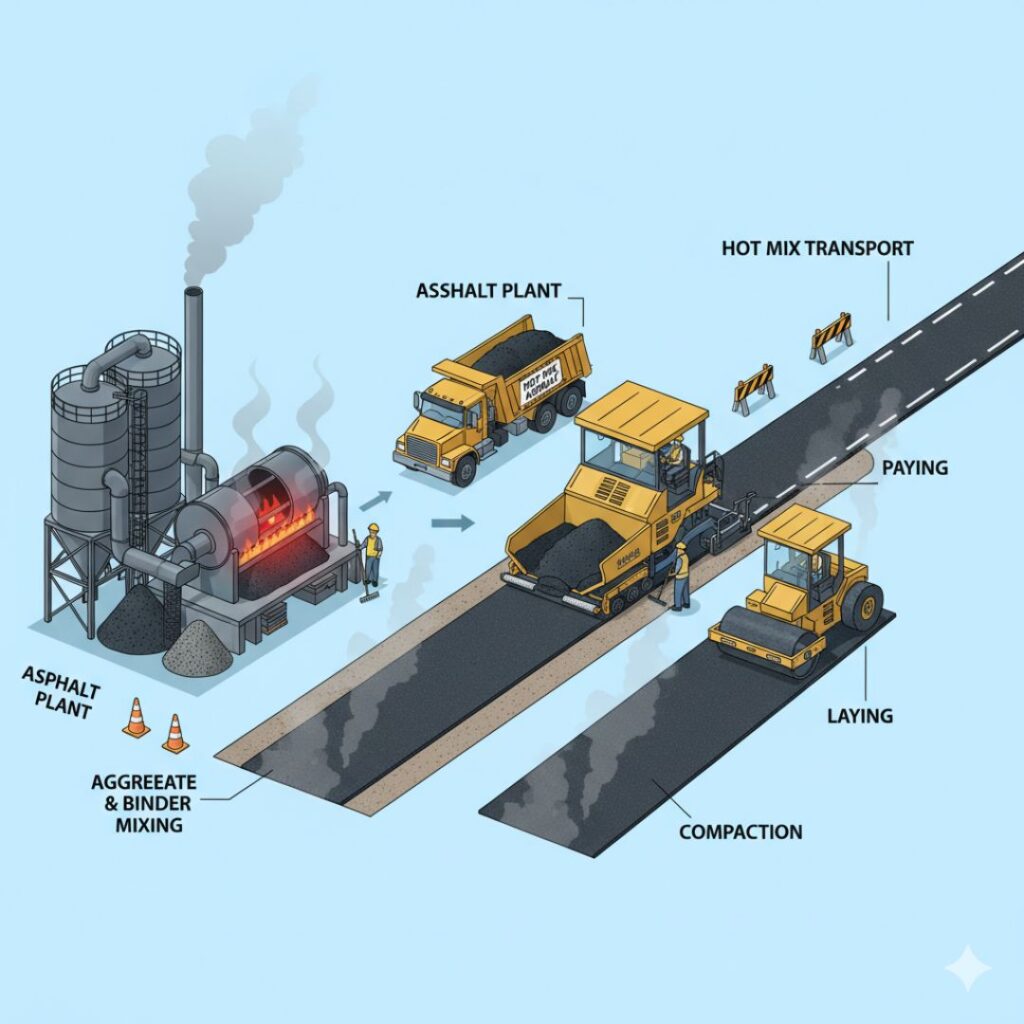
Project scale matters: Small residential jobs benefit from quick estimates, while commercial ones require integrating with BIM software.
Sustainability trends emphasize low-emission mixes, supported by NAPA’s 2024 reports. By optimizing naturally, projects not only save costs but also contribute to greener infrastructure.
Technical Details
The Hot Mix Asphalt Calculator employs standard engineering formulas for accuracy. Volume is calculated as: V (ft³) = Length (ft) × Width (ft) × Thickness (ft), with thickness converted from inches by dividing by 12. Cubic yards = V / 27; cubic meters = cubic yards × 0.764555.
Weight (lbs) = V × Density (lb/ft³), then US tons = lbs / 2000; metric tonnes = US tons / 1.10231. The default density of 145 lb/ft³ aligns with AASHTO T 312 standards for preparing and determining HMA density. Material breakdown assumes 95% aggregate and 5% binder, per typical Superpave mix designs from FHWA and NAPA guidelines.
Cost = Weight (US tons) × Cost per ton, adjusted for units. These adhere to standards like ASTM D3515 for mix specifications and ACI/FHWA recommendations for pavement design.
FAQs: Hot Mix Asphalt Calculator
What measurement units does the Hot Mix Asphalt Calculator support?
How accurate is the Hot Mix Asphalt Calculator for large commercial projects?
Can the Hot Mix Asphalt Calculator account for different asphalt mix designs?
Does the Hot Mix Asphalt Calculator include compaction factors?
How does temperature affect Hot Mix Asphalt Calculator results?
Can I use the Hot Mix Asphalt Calculator for asphalt repair projects?
What waste factor should I add to Hot Mix Asphalt Calculator results?
Related Tools & Calculators: